Changes in maternal and child health due to climate conditions frequently are cascading events. The impact of these factors may be cumulative, starting at pregnancy, through early childhood. This study compared these sequences of exposure and investigated if continuous care decreased the impact of these exposures. Explanatory sequential mixed methods design was followed in three districts of Bangladesh which were at risk due to climate change. A total of 480 pregnant women were included in the quantitative phase and 426 mother-child dyads were followed to 24 months. Information on the environment was combined with clinical information, nutrition data, infection history, and service-use data. Distributed-lag models were used as well as sequence analysis, mixed-effects regression, target-trial emulation and mediation analysis. Twenty-four mothers, partners and frontline health workers were recruited from different and contrasting exposure groups during the qualitative phase. Severe maternal complications (adjusted odds ratio 2.06, 95% confidence interval 1.11-3.82), preterm birth (1.89, 1.05-3.41) and adverse child health at 24 months (2.74, 1.55-4.86) were associated with compound climate, infection, nutrition, and service disruption. A continuum of services lowered the likelihood of negative outcomes for children from 28.7% to 20.1%. This was 12.3 percentage point absolute decline in the lowest socioeconomic group. Qualitative results indicated that transport problems, loss of income, food insecurity and missed referrals exacerbated the impact of short-term climate shocks to become long-term health risks. Climate policy should be integrated with maternal and child health and nutrition support and ongoing care.
Research ArticleMaternal and Child HealthPublished
A Life-Course Exposome for Maternal and Child Health: Linking Climate, Infection, Nutrition, and Health-Service Access
Correspondence: aasif.wales@gmail.com
Abstract
Keywords Climate ChangeExposomeMaternal HealthChild HealthNutrition
1. Introduction
Clinical risk is not the only factor involved in determining maternal and child health. A variety of factors such as heat, flooding, air pollution, infection, food insecurity, housing and access to care frequently collide. Pregnancy and early childhood is a vulnerable time as the body is developing rapidly and not very tolerant of heat, dehydration, infection and poor nutrition. Road damage and destruction of clinics, increased food prices, decreased household income and delayed medical treatment due to extreme weather can also be harmful. It is difficult to discern these combined pressures when they are looked at individually (Pappas et al., 2024; Persson et al., 2025).
The first 1,000 days of life are critical. The heat stress experienced during pregnancy and infancy has been associated with preterm birth, fetal growth issues, altered feeding patterns and reduced child growth. Time of exposure is important, as well. High temperatures for short durations may have a more profound effect at a different time, particularly in times of rapid fetal growth or early feeding than at other times (Bonell et al., 2024; Carlson et al., 2023). Air pollution is another risk, and can be present concurrently with heat and poor housing (Nyadanu et al., 2022).
The role of nutrition and infection is key to this pathway. The impact of climate shocks may include a decrease in food supply, increase in food prices, and reduced dietary options. In hot weather, infant feeding habits can also change and or thirst become a concern. Nutrition can then become deficient due to loss of appetite, decreased absorption and increased energy requirements resulting from infection (Edney et al., 2022; Part et al., 2022; Pérez‐Escamilla & Moran, 2023). Similarly, large-scale studies have confirmed that high temperatures are associated with child growth, with varying magnitudes depending on location and social factors (Ribeiro-Silva et al., 2026; Tusting et al., 2020).
Health services can be a part of the pathway to safety, but they can also be a part of the pathway of risk if care is delayed. Antenatal care, safe delivery, early post-natal contacts, vaccination, nutrition support and early treatment of illness are vital for pregnant women and young children. There has been a shift in the current heat plans where advice and awareness are primarily emphasised and there are less plans addressing transport, outreach, clinical pathways and service continuity (Czerniewska et al., 2025). Similarly, a small and inconsistent evidence-base on maternal and child climate interventions has been found in reviews of the literature (Strong et al., 2025).
Research remains fragmented. Numerous studies focus on the relationship between one climate factor and one birth outcome. There is less information on services in nutrition studies and less information on infections that includes the mother-child pair from the time of pregnancy through childhood. Policy studies outline areas of service failure and do not verify that any of the care pathways could help to minimize harm. Evidence maps indicate that there is a greater increase in studies on climate impacts compared with studies on adaptation and service response (Meherali et al., 2024; Mohamed et al., 2025).
This divide is also so evident in climate policy. Children are frequently identified as vulnerable in National adaptation plans, but few provide much detail on the areas of delivery, finance, staff, referral, or monitoring. Even less attention is given to maternal health and postpartum period (Zangerl et al., 2024). A service response has to therefore go beyond a warning to families about the heat. It needs to support them to reach and stay in care in times of transport, income, food, water or capacity at the clinic strain.
Biological Times must be explained in conjunction with Social Factors. A heat event may affect an individual's body in different ways during early pregnancy, later in pregnancy or infancy. It could also produce different impacts in a safe water-household with safe transport compared with a household without these resources. There are therefore important design requirements for a useful design that must be measured in the same analysis: timing, combined exposure, care pathways and social position.
This can be filled by a life course exposome approach. It takes climate, infection, nutrition, social factors and care as variable and linked exposures. It also asks what time is the peak time for risk and where is the time when a service can interrupt an undesirable chain of events. This approach was used in this study in a linked mother-child cohort. The goals were to find common exposures across the exposure sequences, estimate the associations between maternal exposures, birth outcomes, and child outcomes, identify when exposures were "sensitive" during gestation, estimate the impact of a continuous pathway of care, and provide a rationale for the differences in impact by socioeconomic group.
2. Methods
2.1 Design and Setting
The method used was explanatory sequential mixed methods. The quantitative phase was done prior to the qualitative phase. The outcomes of its work helped to plan the qualitative phase by designing the sample and questions. This resulted in findings being integrated. This design was selected because statistical relationships were not enough to account for the loss of families' access to care or to explain why families who are exposed same to different outcomes. The connected sampling and joint interpretation were conducted based on the recommendations for explanatory sequential studies (James et al., 2024).
The study was carried out in the districts of Gaibandha, Satkhira and Dhaka of Bangladesh. These were the riverine rural, coastal and peri-urban districts as well as low-income urban districts. These have to deal with a recurring lack of water, water flooding, price of food and unequal access to maternal and child services. There were six public antenatal clinics (two in each district) from which participants were chosen.
2.2 Participants and Sample Size
Women were eligible if they were 18 years or older, had a gestation period of 16 weeks or less, had resided in the study area for at least six months and intended to stay for two years following delivery. Women who had multiple pregnancies, major fetal anomalies at recruitment and a condition that had to be managed for a long period of time at tertiary care were excluded.
The sample size was 480 mother-child dyads. This calculation was made assuming that 20% of children would have the primary child outcome, had an odds ratio of 1.7 between the highest and lowest exposure group, was 80% powered, had a two-sided alpha of 0.05 and had a 12% loss to follow-up. The eligible women were invited, one by one, until the required number of women was reached. During the qualitative phase, 24 participants (16 mothers, four partners or household decision makers, and four front line health workers) were involved. Selection included a good range of exposures, continuity of care, socioeconomic position and outcomes.
2.3 Data Collection and Measures
Baseline interviews were conducted which documented age, education, employment, household assets, parity, medical history, food security, housing, water and sanitation, transport and distance to care. The information provided was clinical data including gestational age, blood pressure, haemoglobin, pregnancy complications, antenatal attendance, delivery outcomes, birthweight and postal contact. Follow-up for mothers was carried out one time in each trimester and at 6 weeks after delivery. Assessment of children took place at birth and at 3, 6, 12, 18 and 24 months. The feeding, vaccination, illness, admission, growth and developmental screening measures of child were covered.
The data of the daily temperature, humidity, precipitation, flood and particulate matter were correlated with the home coordinates. Changes of address were noted at each exam. Exposure measures were derived for the weekly period with conception to birth and monthly period with birth to 24 months.
2.4 Exposure and Outcome Definitions
Prior to analysis, four exposure domains were set. Climate Stress, the combination of heat, humidity, air pollution and flood disruption. Infection burden represented maternal febrile illness, neonatal infection, respiratory infection, diarrhea and other recorded infections in children. The three factors-nutrition insecurity, household food insecurity, maternal dietary diversity, gestational weight gain, breastfeeding continuity, and complementary feeding, and food-price shocks-were included in the analysis. Timely antenatal entry, completion of planned contacts, skilled delivery, and postnatal contact within seven days were included in service continuity, as were the other planned components: vaccination, growth monitoring, and referral completion, as well as continuity with a known provider.
The maternal outcome was a composite of severe hypertension, massive bleeding, severe infection, intensive referral or admission to a hospital other than for routine delivery care. The primary birth outcome was preterm birth (<37 weeks). The primary child outcome at 24 months was stunting, occurrence of repeated severe illness, and non-completion of childhood vaccinations and developmental risk. The various components were also analyzed.
2.5 Quantitative Analysis
Descriptive analysis compared between characteristics in exposures sequences. Weather conditions were measured by distributed-lag nonlinear models and outcomes for birth measured. Penalised splines were implemented for the small sample size and because the exposures were very correlated at a weekly time scale. This approach was informed by recent research on multiple correlated exposures (MCExposures) and sensitive windows (Antonelli et al., 2023).
A sequence algorithm was developed along a longitudinal sequence with the grouping of dyads according to the sequence of high exposure and disrupted care and its persistence. Three to five groups were compared based on the criteria of model fit, class size, certainty, and clinical meaning. Adjusted ORs were estimated using GLMMs. The random intercept Clinic was included. Maternal age, parity, BMI, morbidity, education, socio-economic status, place of residence, season of conception and food insecurity prior to pregnancy were adjusted in models.
A target trial was identified that would allow the comparison of usual care with an integrated continuity pathway. It was observed that the pathway had an antenatal registration requirement of at least 16 weeks, and required at least 80% of planned visits, climate and nutrition counselling, delivery and transport plan and postnatal contact within 7 days, and continued vaccination and growth monitoring. Eligibility, treatment, time zero, follow-up, outcomes, and causal contrast were pre-specified and pre-defined based on principles of target trials (Hernán et al., 2022). First and 99th percentile of stabilised inverse-probability weights were used to trim the data. Standardized risks, risk ratios and risk differences were obtained by using weighted pooled logistic models.
Indirect effects were estimated using mediation analysis, with birth outcomes, infection, nutrition insecurity and service interruption as mediators. Here, 1,000 bootstraps were used in constructing confidence intervals. Multiple imputation by chained equations was used to deal with missing data. Checks included complete-case models, other sequence solutions, different weight limits, and limiting to medically indicated preterm. Data were analyzed with SPSS V25.
2.6 Data Quality and Bias Control
Standard forms were used by field staff and they were trained prior to recruitment. Anthropometric equipment was checked daily and 10% of the data was compared to the source data. Address during each period (not address at recruitment) was used for exposure linkage. Outline of analysis plan was established prior to the modelling of outcomes. Directed causal diagrams were used to help select the most appropriate variables for inclusion in the analysis and to prevent adjustment for variables on the causal pathway.
Socioeconomic position was measured according to assets, mother's education, housing and travel time to care. Effect-modification analysis performed the score tertiled. Windows outside the main biological period were examined to see if there is any clear association, but no association was seen. Prior to the acceptance of final estimates, variance inflation, extreme weights and model residuals were checked.
2.7 Qualitative Phase and Integration
The subject areas of heat, flooding, sickness, food availability, infant feeding, transport, care seeking, referral, cost, trust and continuity were explored in semi structured interviews. Mothers were chosen within the exposure sequences including women with various outcomes in each sequence. The health workers were recruited from clinics that ranged from high to low continuity scores. Interviews took place in a confidential location of the participant's choice, and lasted approximately 35-60 minutes. Early interviews with the guide resulted in the adjustment of the guide to allow greater detail to be included on the transport, service re-entry, and feeding support.
Interviews were tape-recorded, transcribed and analyzed using framework analysis. The initial coding frame was comprised of the four domains of exposure, and additional codes were created as participants identified issues that were not captured in this initial coding. An initial set of transcripts was later read again by a second trained coder and any discrepancies were discussed to reach an agreement. The mothers, partners and health workers were then compared to each other by using a matrix. Patterns were analyzed, differences between groups and accounts, which did not fit the main pattern, were analyzed. Reflexive notes were made following interviews, and during coding. Pathway summaries and side-by-side comparisons of quantitative and qualitative results were used to go through connected sampling, side-by-side comparisons, and case-based pathway summaries.
2.8 Ethics and Reporting
Ethical approval has been obtained from University of Wales Trinity Saint David, United Kingdom University Research Ethics Committee (UREC-MPH-2026-0147). All participants, as well as their children, provided written informed consent for follow up, record linkage, geocoding, and interviews. Data were anonymized prior to analysis and mapped data were only reported as averages. The quantitative part was drafted in accordance with the STROBE principles and the mixed-methods part was reported according to recommended guidelines.
3. Results
3.1 Participant Flow and Profile
Table 1 shows that a total of 536 eligible women were approached; 480 women registered for the program. A total of 426 dyads underwent follow-up at 24 months (88.8% retention). Twenty-seven families opted to live outside the study area, 18 chose to opt of the study and, 9 families could not be contacted. Although more families who were renters and families who moved a lot were lost to follow-up, they were not significantly different in terms of baseline age, parity, health, or exposure to climate hazards during the first trimester.
Table 1. Participant profile and main outcomes
| Characteristic | Frequency (n) | Percent (%) | Mean (SD) |
|---|---|---|---|
| Completed mother–child dyads | 426 | 100.0 | - |
| Maternal age, years | - | - | 26.8 (5.1) |
| Lowest socioeconomic tertile | 154 | 36.2 | - |
| Rural residence | 186 | 43.7 | - |
| Peri-urban residence | 121 | 28.4 | - |
| Antenatal registration by 16 weeks | 247 | 58.0 | - |
| Facility delivery | 318 | 74.6 | - |
| Postnatal contact within 7 days | 204 | 47.9 | - |
| Complete vaccination at 24 months | 307 | 72.1 | - |
| Severe maternal complication | 47 | 11.0 | - |
| Preterm birth | 53 | 12.4 | - |
| Low birthweight | 63 | 14.8 | - |
| Adverse child composite at 24 months | 103 | 24.2 | - |
There were a significant proportion of low income and rural people in the cohort. Access to antenatal care was moderate and contact with mothers early postnatal care was low. Child outcome was frequent enough to warrant adjusted analysis, but was not large enough to warrant adjusting for. This helped to support the use of composite outcomes and to minimize the number of model terms.
3.2 Exposure-service Sequences
Four sequences proved to be a good compromise of fit, class size and clinical meaning. They are distributed and their outcomes as demonstrated in Table 2.
Table 2. : Remember Style and The Child Health Pattern
| Exposure-service sequence | N (%) | Lowest SES (%) | Child composite (%) | Mean HAZ |
|---|---|---|---|---|
| Low exposure, high continuity | 132 (31.0) | 23 | 14.4 | -0.58 |
| Heat dominant, moderate continuity | 108 (25.4) | 33 | 20.4 | -0.74 |
| Infection-nutrition disruption | 115 (27.0) | 39 | 28.7 | -1.01 |
| Compound disruption | 71 (16.7) | 49 | 40.8 | -1.24 |
In the four-sequence solution, it was found that there was no single pattern of climate stress. The compound-disruption group was the smallest, but was characterized by child outcomes being the poorest and by low-income children being most prevalent. The low exposure-high continuity group showed the best growth. These discrepancies aided in the use of ordered exposure pathways as opposed to a single exposure score.
3.3 Critical Windows and Adjusted Associations
Distributed-lag analysis was used to determine the primary window for preterm birth as gestational weeks 24-31. The peak occurrence of the association was at week 28. At that time, an increase of one SD (standard deviation) in weekly climate stress was associated with a 13% increase in the risk for Preterm Birth. The cumulative adjusted odds ratio across weeks 24-31 was 1.36 (95% CI 1.08-1.72). The window for low birthweight was later, around weeks 28-35.
Table 3. : Adjusted Associations Between Exposure-Service Sequence and Outcomes
| Sequence | Maternal complication aOR | Lower 95% CI | Upper 95% CI | Preterm birth aOR | Lower 95% CI | Upper 95% CI | Child composite aOR | Lower 95% CI | Upper 95% CI |
|---|---|---|---|---|---|---|---|---|---|
| Low exposure, high continuity | 1.00 | Ref. | Ref. | 1.00 | Ref. | Ref. | 1.00 | Ref. | Ref. |
| Heat dominant, moderate continuity | 1.31 | 0.68 | 2.51 | 1.54 | 0.83 | 2.84 | 1.42 | 0.78 | 2.58 |
| Infection-nutrition disruption | 1.58 | 0.83 | 3.01 | 1.33 | 0.71 | 2.48 | 2.01 | 1.14 | 3.55 |
| Compound disruption | 2.06 | 1.11 | 3.82 | 1.89 | 1.05 | 3.41 | 2.74 | 1.55 | 4.86 |
The compound-disruption sequence was most associated with all outcomes after adjusting for the other sequences. The relationship between the infection-nutrition sequence was stronger with the child outcome than with preterm birth. This implies that there was a risk of post-natal infection and feeding routes as well. Heat-dominant group had less accurate and less strong estimates with partial access to care.
3.4 Estimated Effect of The Continuity Pathway
Target-trial models with weights were compared with usual care. Figure 1 presents the standardized results.
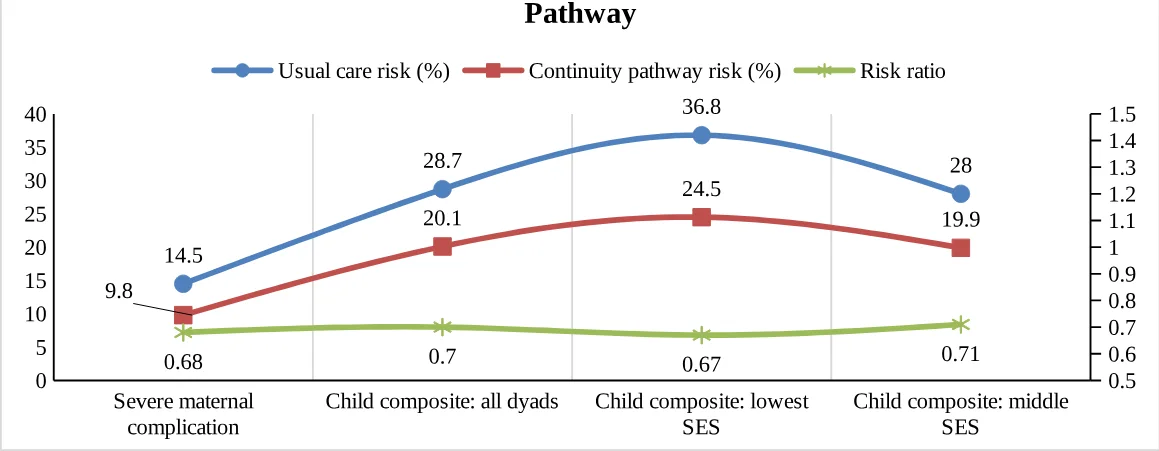
The integrated continuity pathway was associated with lower risks compared to usual care. The severe maternal complication rate went down from 14.5% to 9.8% (RR = 0.68) and the child composite outcome rate among all dyads decreased from 28.7% to 20.1% (RR = 0.70).
Reductions were noted in all socioeconomic groups, with the highest reduction noted for the lowest-SES group, where the rate of child composite risk was reduced from 36.8% to 24.5% (RR = 0.67). This implies that the route could contribute to better maternal and child outcomes and to a decrease of socioeconomic inequalities.
3.5 Mediation, Equity and Sensitivity Analyses
None of the pathways had the climate-child association. The total association was due to adverse birth outcomes (19%), recurrent infection (27%), nutrition insecurity (23%) and service interruption (17%). The remaining 14% referred to direct effects and pathways which were not measured by the mediators. The relative effects across groups were closer, while the absolute benefit was greatest in the lowest socio-economic group, for the continuity pathway. Estimates were in the same direction from complete case analysis, alternative sequence solutions, various weight trimming and exclusion of medically indicated preterm births. The trends were not apparent for the negative-control windows.
3.6 Qualitative Findings
Qualitative sample comprised 16 mothers, four partners or household decision makers and four front-line workers. All four exposure conditions were represented as were all three socio-economic groups. The analysis was directed towards the ways in which risk was built up, how the care had been interrupted and what supported families to resume care.
There were four themes which were linked to the quantitative pattern. The first theme was compound household pressure. Mothers did not report ‘separate’ events of heat and flooding. They had days when it was hot, they lost work, they had to pay for water, they didn't have enough food to eat, and they were sick. Often a visit was postponed due to the need to attend to food, shelter or a sick child.
Cascading service disruption was the second theme. It was common for a single absence to be followed by another. Women who were not tested earlier, were tested later and were found to be at higher risk. Early post-natal visit was also not received by mothers who were not seen during their post-natal period. A failure to attend a vaccination visit, then, led to lower subsequent contact with growth monitoring. Failure to attend a vaccination visit then lowered subsequent growth monitoring contact. These breaks were seen by participants as a series of failures and not as a single failure.
The third theme was that of relational continuity. Where a known community worker or midwife had been seen by the mother, earlier advice seeking was found and mothers were more likely to complete a referral. They were also re-referred for care for failure to attend. Continuity was defined as "connection with a trusted individual who is available to connect pregnancy, birth, and child care - not in the sense of the number of clinic visits.
The fourth theme was the lack of equality in the ability to follow advice. Recommendations for rest, increased water intake, avoiding heat and going to a clinic or improving diets made the assumption that families could afford money, time, water, travel and support. Frequently, low-income homes did not have these assets. Standard counselling was also found not to always align with families' choices by health workers.
Contrasting cases also were provided. A health worker was able to keep in touch with some women in the heat-dominated group who had good outcomes due to the support of family members who were able to transport, provide food and childcare. A few families in the lower exposure group experienced poor outcomes with delayed infection and referral. These cases demonstrated that it was not pathway per se that was determined by climate exposure.
Table 4. Qualitative themes and mixed-methods interpretation
| Theme | Pattern in the Accounts | Mixed-methods Meaning |
|---|---|---|
| Compound household pressure | The combination of heat and flood effects increased when they occurred in combination with lost income, high water and travel costs, food shortage, or acute illness. | Explained the high risk of the compound disruption sequence. |
| Cascading service disruption | Losing one test or visit typically resulted in further losses in feeding support, vaccination and growth monitoring services. | Sustained the continuity of care throughout the stages. |
| Relational continuity | Early advice and advice completion and return following missed care were all improved by a known worker or midwife. | Described some of the protective effects of the continuity pathway. |
| Unequal ability to follow advice | Low-income families did not have access to water, cooling, transport, time, or food choice. | Suggested that a greater absolute improvement occurred in the bottom socioeconomic group. |
The two strands ended up in the same explanation. The compound group had a high outcome gradient, due to a number of pressures coming at once and building up over time. The reasons for the continuity pathway being protective were given from a qualitative perspective. It has enhanced early detection, referral, support for disruption in feeding and vaccination, and enhancing re-entry to care following disruption. These findings also indicated not to use the pathway as a checklist. It requires flexibility of visits, outreach and transport, and follow-up responsibility.
The qualitative strand also revealed the potential for different ways of working, for the same intervention. Transport planning was the primary benefit with some families. The advantage for others was the presence of a known worker who would be able to provide feeding or referral. This variation is what makes it important that core functions are defined via a pathway with flexibility for the delivery being local.
4. Discussion
The study revealed that the sequences of exposures had an impact on maternal and child risk, rather than climate. The most pronounced impacts were in the climate stress followed by infection and nutrition insecurity and a gap in care. Infant health outcomes of compound disruption were associated with significant maternal complications, preterm birth and poor child health. The continuity pathway saw a reduction in predicted risk, with the greatest risk being seen in disadvantaged households.
The sensitive period for the preterm birth was from 24-31 gestational weeks. This is when the fetus grows rapidly and the mother's heart and blood vessels need more and more blood. In other contexts, weekly averages have been shown to mask short time segments of risk (Carlson et al., 2023; Kanner et al., 2020). The outcome is used to provide heat advice and provide service planning which is correlated to the stage of gestation instead of one message across the entire gestation.
When birth outcomes were taken into account in the analysis, the child findings were not accounted for. Infection and nutrition had a bigger proportion of the climate-child relationship compared to preterm birth and low birth weight. This aligns with findings that hot weather can impact feeding, as well as with increased exposure to hot weather being associated with poor child growth (Bonell et al., 2024; Edney et al., 2022; Ribeiro-Silva et al., 2026). It also highlights the reasons why an erosion study only to delivery will be incomplete in terms of the burden that may be caused later.
Practical aspect of protection is the continuity of services. While there is a current focus on giving children advice about their heat plans, advice is not necessarily useful if children don't have access to water, transport, income, staff and referring (Czerniewska et al., 2025). Strong et al. (2025) conducted a mapping review of maternal and child service (MCS) responses that were tested as well and again few responses were identified. This study has shown that the simple linked pathway has a better performance than early antenatal entry alone. The outcome is a service package which allows a link between antenatal care, delivery planning, early postnatal contact, vaccination, nutrition and growth monitoring.
Policy relevance of a socioeconomic outcome. There were relatively smaller effects than absolute effects since poorer families had a higher risk to begin with. A similar service can thus cause less harm to a low-income group if it is close across groups. Absolute risk should be used for climate adaptation-not just the average coverage. The support in transport, outreach, flexible working hours, food support and community follow-up should be targeted at the most vulnerable households who are less likely to take action on advice.
This was a mixed-methods design which added value. The high-risk sequence was identified using quantitative models, and the process of the formation of the high-risk sequence was revealed during the interviews. This led to changes in arrangements for care due to lost income or increased transport costs. Support was provided from a trusted agency to assist families to return following disruption. These mechanisms, which would have been difficult to discern from the normal records, would have been of great importance. Another thing that the integration did was avoid a narrow definition of heat as being a biological exposure only.
The results lead to a number of changes in services. There should be a plan for the continuity of the mother and child as well as a public alert when there is a heat or flood alert issued. Pregnant women and young children that are potentially at risk of not attending care and how to reach them, a backup referral pathway and a clear pathway for follow up responsibility in the clinic. As far as possible, nutrition and infection assessments should be performed at the same time. There is a need for community workers to be trained and provided safe working conditions, supplies and a formal linkage to facilities to assist.
The outcomes also aid in the measurement. Future cohorts to document move, work exposure, water access, food prices and when services were missed. Then, there are the effects of heat, pollution, flood and infection which could be separated out in larger samples, but still be modelled. Future research is warranted to explore school readiness, subsequent development, mental health in the mothers and cardio-metabolic outcomes. Economic analysis should be performed to determine if the risk associated with transport, outreach and continuity is decreased, as well as the cost.
Only the context is what's required to be generalizable. Bangladesh is densely populated, exposed to a high level of seasonal risk, and has a hybrid care system (public and informal). The actual sizes of the sequences may vary in other countries. However, the primary mechanism is probably more general and is that the stress of the environment is more detrimental when it is coupled with infection and inadequate nutrition as well as a gap in care. Multi-cohort replication would indicate those parts that are common and those that require local adaptation.
There were a number of strengths of this study. It correlated environmental, clinical, nutritional and infection data and service data for the same dyads. It was based on weekly pregnancy measurements, tracked the children up to 24 months and chose qualitative cases from the quantitative findings. The specification of the target trial was a clear indication of the care. All of the above were updated during follow-up and contrasted and unexpected cases were performed in the qualitative analysis. The improvement of these features helped to enhance the time and interpretation of these estimates.
There are a number of constraints that need to be taken into account. Due to the small sample size for a study of the high-dimensional exposome, four domains of exposure were combined and controls were placed on the lag functions. There were some very serious maternal disorders which could not be investigated in isolation. Record and caregiver-reported data were used to obtain infection information, which might have resulted in misclassification. Service continuity was not randomly assigned, which means that it is possible that there is residual confounding even after weighting. Mobile families' loss to follow-up was higher and this family may also have experienced unstable care. The data were combined into the child composite by combining outcomes that have differing clinical meaning. Good assumptions were made about confounding between exposure, mediator and outcome for mediation estimates. Follow-up was terminated at 24 months and post school outcomes and adolescent and maternal outcomes were not assessed.
5. Conclusion
Maternal and child health risks are caused by ordered and linked exposures. The greatest impact of climate stress was in combination with infection, food and nutrition insecurity, social disadvantage and broken care. The period of gestation 24-31 weeks was a vulnerable time for preterm birth, and infection, feeding and service pathways persisted the risk post-birth. An integrated continuity pathway was associated with reduced maternal and child risk and the greatest absolute positive effect was observed in the lowest (most vulnerable) socioeconomic group. Environmental warning information should thus be linked to maternal and child services to safely deliver, monitor growth, provide nutrition support, and control infection as well as ensure early postnatal contact and vaccination; maternal and child services should be made climate-resilient. Larger, longer linked cohorts, with continued attention to timing and sequence, service continuity, and equity, are warranted for future studies.
Acknowledgements
The author thanks the mothers, family members, health workers, clinic workers and field team who helped in this study and follow-up exercises.
Declarations
This study has been approved by the University of Wales Trinity Saint David, United Kingdom University Research Ethics Committee (UREC-MPH-2026-0147). Written informed consent was obtained from all the participants. Follow-up and record linkage were done with the consent of parents or legal guardians of children.
Consent for Publication
Not applicable.
Funding
This research was not supported by any specific grant from any funding agency in the public, commercial or not-for-profit sectors.
Competing Interests
The author has no competing interests.
Data Availability
The corresponding author can provide de-identified data on reasonable request upon reasonable ethical approval, participants' consent, as well as data sharing agreements.
Author Contributions
Mahir Al Asif Masrur: Conceptualization, methodology, investigation, data curation, formal analysis, qualitative analysis and integration of mixed methods, writing-original draft, writing-review and editing, project administration. The author has finished all the manuscript and takes the responsibility for it.
Declaration of Generative AI Use
Language editing, sentence transformation, organization and formatting of documents was supported by generative AI. It had no scientific functions or was used to gather study data and final scientific decision. The author has read the whole work, verified all references and interpretation and is responsible for the content of the work submitted.
References
- Antonelli, J., Wilson, A., & Coull, B. A. (2023). Multiple exposure distributed lag models with variable selection. Biostatistics, 25(1), 1–19. https://doi.org/10.1093/biostatistics/kxac038
- Bonell, A., Vicedo-Cabrera, A. M., Moirano, G., Sonko, B., Jeffries, D., Moore, S. E., Haines, A., Prentice, A. M., & Murray, K. A. (2024). Effect of heat stress in the first 1000 days of life on fetal and infant growth: A secondary analysis of the ENID randomised controlled trial. The Lancet Planetary Health, 8(10), e734–e743. https://doi.org/10.1016/S2542-5196(24)00208-0
- Carlson, J. M., Zanobetti, A., Ettinger De Cuba, S., Poblacion, A. P., Fabian, P. M., Carnes, F., Rhee, J., Lane, K. J., Sandel, M. T., & Janulewicz, P. A. (2023). Critical windows of susceptibility for the effects of prenatal exposure to heat and heat variability on gestational growth. Environmental Research, 216, 114607. https://doi.org/10.1016/j.envres.2022.114607
- Czerniewska, A., Brimicombe, C., Saez Reale, A., Shumake-Guillemot, J., Sharkey, A., & Portela, A. (2025). How is maternal, newborn, and child health addressed in Heat Health Action Plans? A scoping review and content analysis. Journal of Global Health, 15, 04157. https://doi.org/10.7189/jogh.15.04157
- Edney, J. M., Kovats, S., Filippi, V., & Nakstad, B. (2022). A systematic review of hot weather impacts on infant feeding practices in low-and middle-income countries. Frontiers in Pediatrics, 10, 930348. https://doi.org/10.3389/fped.2022.930348
- Hernán, M. A., Wang, W., & Leaf, D. E. (2022). Target Trial Emulation: A Framework for Causal Inference From Observational Data. JAMA, 328(24), 2446. https://doi.org/10.1001/jama.2022.21383
- James, T. G., DeJonckheere, M., & Guetterman, T. C. (2024). Integrating Transformative Considerations and Quantitative Results Through a Participant Selection Joint Display in Explanatory Sequential Mixed Methods Studies. Journal of Mixed Methods Research, 18(1), 14–30. https://doi.org/10.1177/15586898221149470
- Kanner, J., Williams, A. D., Nobles, C., Ha, S., Ouidir, M., Sherman, S., & Mendola, P. (2020). Ambient temperature and stillbirth: Risks associated with chronic extreme temperature and acute temperature change. Environmental Research, 189, 109958. https://doi.org/10.1016/j.envres.2020.109958
- Meherali, S., Aynalem, Y. A., Nisa, S. U., Kennedy, M., Salami, B., Adjorlolo, S., Ali, P., Silva, K. L., Aziato, L., Richter, S., & Lassi, Z. S. (2024). Impact of climate change on child outcomes: An evidence gap map review. BMJ Paediatrics Open, 8(1), e002592. https://doi.org/10.1136/bmjpo-2024-002592
- Mohamed, M., Amin, S., Lever, E., Montini, A., Machida, K., Rajagopalan, S., Costello, A., McGushin, A., Jennings, B., Benoit, L., Saville, N., Walshe, N., Dalglish, S. L., Ayeb-Karlsson, S., Sterlini, S., & Prost, A. (2025). Climate change and child wellbeing: A systematic evidence and gap map on impacts, mitigation, and adaptation. The Lancet Planetary Health, 9(4), e337–e346. https://doi.org/10.1016/S2542-5196(25)00061-0
- Nyadanu, S. D., Dunne, J., Tessema, G. A., Mullins, B., Kumi-Boateng, B., Lee Bell, M., Duko, B., & Pereira, G. (2022). Prenatal exposure to ambient air pollution and adverse birth outcomes: An umbrella review of 36 systematic reviews and meta-analyses. Environmental Pollution, 306, 119465. https://doi.org/10.1016/j.envpol.2022.119465
- Pappas, A., Kovats, S., & Ranganathan, M. (2024). Extreme weather events and maternal health in low-income and middle-income countries: A scoping review. BMJ Open, 14(6), e079361. https://doi.org/10.1136/bmjopen-2023-079361
- Part, C., Filippi, V., Cresswell, J. A., Ganaba, R., Hajat, S., Nakstad, B., Roos, N., Kadio, K., Chersich, M., Lusambili, A., Kouanda, S., & Kovats, S. (2022). How do high ambient temperatures affect infant feeding practices? A prospective cohort study of postpartum women in Bobo-Dioulasso, Burkina Faso. BMJ Open, 12(10), e061297. https://doi.org/10.1136/bmjopen-2022-061297 Pérez‐Escamilla, R., & Moran, V. H. (2023). Maternal and child nutrition must be at the heart of the climate change agendas. Maternal & Child Nutrition, 19(1), e13444. https://doi.org/10.1111/mcn.13444
- Persson, I., Sturm, A., Manchikanti, S., Nilsson, M., Ebi, K. L., Solomon, A., Alfven, T., & Helldén, D. (2025). Impacts of climate change during pregnancy, perinatal period and infancy: A systematic review. BMJ Paediatrics Open, 9(1), e002895. https://doi.org/10.1136/bmjpo-2024-002895
- Ribeiro-Silva, R. D. C., Luz, L. P., Sacramento, L. S., Cortes, T. R., Ribeiro, L. H. L., Pepper, M., Delgado, D., Pescarini, J. M., Rebouças, P., Silveira, I. H., Costa, P. R. D. F., Ranzani, O. T., Paixão, E. S., & Maurício L Barreto. (2026). Ambient temperature and child nutritional status of more than 6 million children in Brazil: A cohort study. The Lancet Planetary Health, 10(2), 101428. https://doi.org/10.1016/j.lanplh.2026.101428
- Strong, J., Barrett, R., Surtee, Z., O’Hare, M., Conway, F., & Portela, A. (2025). Interventions to reduce the effects of air pollution and of extreme heat on maternal, newborn, and child health outcomes: A mapping of the literature. Journal of Global Health, 15, 04035. https://doi.org/10.7189/jogh.15.04035
- Tusting, L. S., Bradley, J., Bhatt, S., Gibson, H. S., Weiss, D. J., Shenton, F. C., & Lindsay, S. W. (2020). Environmental temperature and growth faltering in African children: A cross-sectional study. The Lancet Planetary Health, 4(3), e116–e123. https://doi.org/10.1016/S2542-5196(20)30037-1
- Zangerl, K. E., Hoernke, K., Andreas, M., Dalglish, S. L., Kelman, I., Nilsson, M., Rockloev, J., Bärnighausen, T., & McMahon, S. A. (2024). Child health prioritisation in national adaptation policies on climate change: A policy document analysis across 160 countries. The Lancet Child & Adolescent Health, 8(7), 532–544. https://doi.org/10.1016/S2352-4642(24)00084-1
CITE THIS ARTICLE
Masrur, M. A. A. (2025). A Life-Course Exposome for Maternal and Child Health: Linking Climate, Infection, Nutrition, and Health-Service Access. International Journal of Medical and Health Research, 3(4), 120–131. https://doi.org/10.61424/ijmhr.v3i4.1086
M. A. A. Masrur, “A Life-Course Exposome for Maternal and Child Health: Linking Climate, Infection, Nutrition, and Health-Service Access,” International Journal of Medical and Health Research, vol. 3, no. 4, pp. 120–131, 2025. doi: 10.61424/ijmhr.v3i4.1086.
Masrur, M. A. A. (2025) ‘A Life-Course Exposome for Maternal and Child Health: Linking Climate, Infection, Nutrition, and Health-Service Access’. International Journal of Medical and Health Research, 3(4), 120–131. Available at: https://doi.org/10.61424/ijmhr.v3i4.1086
Masrur, Mahir Al Asif. “A Life-Course Exposome for Maternal and Child Health: Linking Climate, Infection, Nutrition, and Health-Service Access.” International Journal of Medical and Health Research, 3(4), 120–131, 2025, https://doi.org/10.61424/ijmhr.v3i4.1086.
Mahir Al Asif Masrur. “A Life-Course Exposome for Maternal and Child Health: Linking Climate, Infection, Nutrition, and Health-Service Access.” International Journal of Medical and Health Research, 3(4), 120–131 (2025). https://doi.org/10.61424/ijmhr.v3i4.1086.
Masrur MAA. A Life-Course Exposome for Maternal and Child Health: Linking Climate, Infection, Nutrition, and Health-Service Access. International Journal of Medical and Health Research. 2025;3(4):120–131. https://doi.org/10.61424/ijmhr.v3i4.1086
@article{article_5923b2c62cc74ab9a6408aaf353f232f,
  title = {A Life-Course Exposome for Maternal and Child Health: Linking Climate, Infection, Nutrition, and Health-Service Access},
  author = {Mahir Al Asif Masrur},
  year = {2025},
  journal = {International Journal of Medical and Health Research},
  volume = {3},
  number = {4},
  pages = {120–131},
  doi = {10.61424/ijmhr.v3i4.1086},
  url = {https://www.researchbymahir.com/article/5923b2c6-2cc7-4ab9-a640-8aaf353f232f},
}
TY - JOUR AU - Mahir Al Asif Masrur TI - A Life-Course Exposome for Maternal and Child Health: Linking Climate, Infection, Nutrition, and Health-Service Access PY - 2025 JO - International Journal of Medical and Health Research VL - 3 IS - 4 SP - 120 EP - 131 DO - 10.61424/ijmhr.v3i4.1086 UR - https://www.researchbymahir.com/article/5923b2c6-2cc7-4ab9-a640-8aaf353f232f ER -